University of Groningen
University of Groningen PO Box 72 9700 AB Groningen the Netherlands
About

University Type
Public

Groningen,
Netherlands

Year Established:
1614
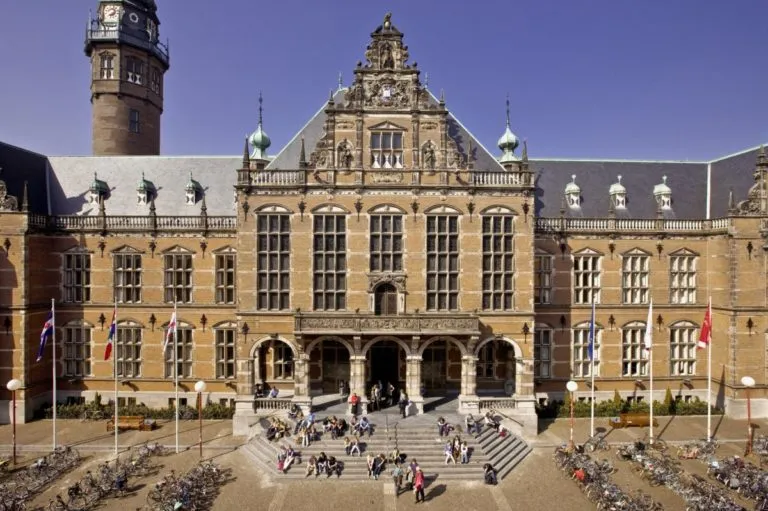
The University of Groningen (abbreviated as UG; Dutch: Rijksuniversiteit Groningen, abbreviated as RUG) is a public research university of more than 30,000 students in the city of Groningen in the Netherlands. Founded in 1614, the university is the second oldest in the country (after Leiden) and one of the most traditional and prestigious universities in the Netherlands. The institution has been consistently ranked among the top 100 universities in the world, according to leading ranking tables. In the 2022 Aggregate Ranking of Top Universities, RUG is ranked fourth in the Netherlands. The University of Groningen has eleven faculties, nine graduate schools, 27 research centers and institutes, and more than 175-degree programs. The university's alumni and faculty include Johann Bernoulli, Aletta Jacobs, four Nobel Prize winners, nine Spinoza Prize winners, one Stevin Prize winner, various members of the Dutch royal family, several politicians, the first president of the European Central Bank, and a secretary general of NATO.
Rankings

#159
QS

#76
USNews
University of Groningen Program Rankings
-
Psychology (UG) - Rank #28 (US News)
-
International Relations & International Organization (UG) - Rank #35 (US News)
-
Economics & Business Economics (UG) - Rank #49 (US News)
-
Biology (UG) - Rank #128 (US News)
-
Applied Physics (UG) - Rank #132 (US News)
-
Physics (UG) - Rank #132 (US News)
-
Chemistry (UG) - Rank #158 (US News)
-
Biomedical Engineering (UG) - Rank #350 (QS)
-
Chemical Engineering (UG) - Rank #350 (US News)
-
Industrial Engineering & Management (UG) - Rank #350 (US News)
-
Artificial Intelligence (UG) - Rank #464 (US News)
-
Computing Science (UG) - Rank #464 (US News)
University of Groningen Highlights
FAQs
What are the most popular graduate programs offered at University of Groningen?
The University of Groningen offers a diverse range of popular graduate programs, including International Law, Human Rights, Sustainable Entrepreneurship, and Environmental and Energy Management. These programs are renowned for their innovative curriculum and strong focus on research, preparing students for global challenges in their respective fields.
What is the Annual Cost of attendance at University of Groningen?
The annual tuition fee for non-EU/EEA students typically ranges from €8,000 to €16,000, depending on the program. The estimated cost of living is around €10,000 per year. Using a rough conversion rate of 1 Euro = 85 INR (as of the latest rates), the total cost for a year can range from approximately 15.3 lakhs INR to 22.1 lakhs INR, rounded to the nearest hundreds.
What Financial aid and scholarship options are available at University of Groningen?
University of Groningen offers various scholarships like the Eric Bleumink Fund and Talent Grant for international students. Applicants are encouraged to apply for scholarships concurrently with their program application. Detailed information and application procedures are available on the university’s official website, where students can access eligibility criteria, deadlines, and necessary documentation.
What is the reputation and ranking of University of Groningen?
The University of Groningen consistently ranks among the top universities globally, especially noted for its programs in Arts & Humanities, Social Sciences, and Life Sciences. In the QS World University Rankings by Subject, several of its disciplines are ranked within the top 100, reflecting its commitment to academic excellence and research impact.
What is the campus culture like at University of Groningen?
The campus culture at the University of Groningen is vibrant and diverse, with numerous student organizations, sports clubs, and cultural societies. The university hosts annual events such as the KEI-week, an introductory week for new students, and the International Student Festival. These activities provide a rich, interactive environment for students to engage and immerse in a dynamic community.
What are the housing options at University of Groningen?
The University of Groningen offers on-campus housing which is quite competitive. Many students opt for off-campus housing in areas like Paddepoel, Korrewegwijk, and the city center, which are popular due to their proximity to university buildings and vibrant student life. These areas provide a range of housing options from studio apartments to shared flats, catering to different preferences and budgets.
Similar Universities